What currency is used in Indonesia and Bali: what money to bring
What currency is used in Indonesia and Bali, and should you bring dollars or euros? How to compare the final amount in rupiah after fees and prepare money for your initial expenses.

Quick answer
The currency in Indonesia, including Bali, is the Indonesian rupiah: have rupiah ready for everyday expenses, and choose dollars or euros based on the savings you already have and the total cost of exchanging them. We recommend comparing the final amount of rupiah after all exchanges and planning your initial expenses in advance.
Check which currencies you already have
Start with the dollars or euros you already have. An additional exchange makes sense if the calculation shows you will receive more rupiah after all costs.
Compare the amount you will receive
Account for buying currency before your trip, fees, and the subsequent exchange into local money.
Prepare for your first payments
Find out how to pay for transport from the airport and food before your main currency exchange.
Choose a backup
Arrange a backup way to get rupiah that does not depend on your main card or a single exchange office.
What currency do you need in Bali, and how do you read amounts in rupiah?
Bali and the other Indonesian islands use the Indonesian rupiah; IDR and Rp refer to the same currency. The international code appears in banking transactions, while Rp appears next to amounts. The Indonesian rupiah should not be confused with the Indian rupee: INR is the currency code for India.
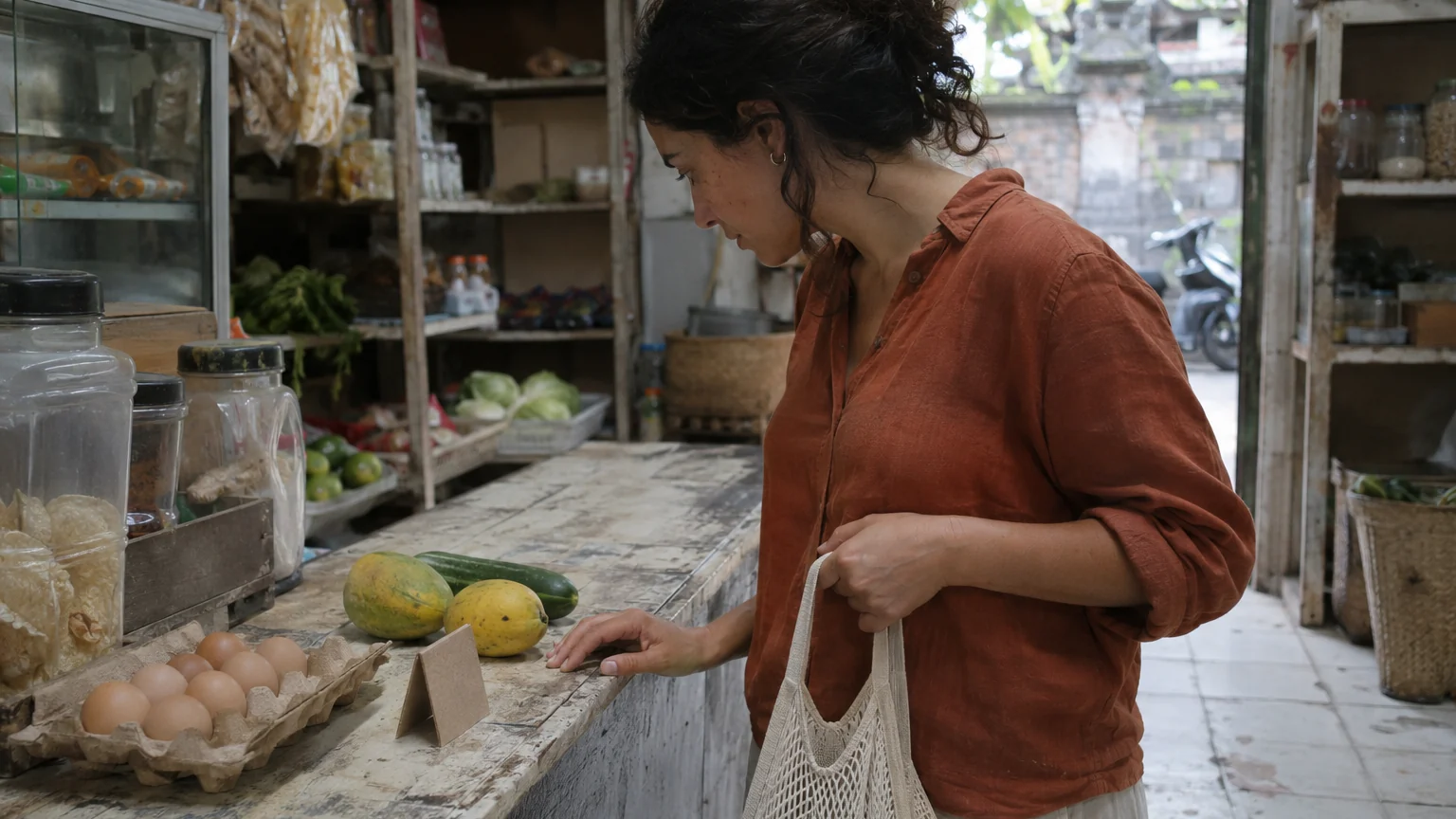
How to recognize the local currency
- Name
- Indonesian rupiah
- International code
- IDR
- Symbol
- Rp
- Banknote denominations in the 2022 series
- 1 000, 2 000, 5 000, 10 000, 20 000, 50 000 and 100 000 rupiah
The denominations and description of the series are based on Bank Indonesia's announcement of the 2022 banknote issue.
In Bank Indonesia's catalog, Rp 50.000 means 50 000 rupiah: the period separates thousands. When checking a price and your change, read the full amount first. If an amount is abbreviated on a menu or in a seller's message, ask for the full price in rupiah.
The 2022 series banknotes feature Indonesia's national heroes. When paying, rely primarily on the printed denomination, rather than just the portrait or color. This helps you distinguish between banknotes while you are still getting used to the local currency.
What should you bring to Bali: euros or dollars you already have, or rupiah bought in advance?
The choice depends on which currencies you already have and how much rupiah you will receive after all exchanges. Assess buying rupiah before departure separately: compare availability, the total cost, and convenience for your initial expenses.

You already have euros
Compare a direct exchange into rupiah with exchanging via dollars.
You already have dollars
Confirm how much you will receive for your banknotes before buying another currency.
You need to buy currency
Calculate the result for the same budget in rubles.
If you already have euros, do you need to buy dollars?
Buying dollars to replace euros you already have only makes sense if the final calculation shows you will receive more rupiah after all costs. Ask for the terms for exchanging euros directly in Indonesia and compare them with exchanging via dollars. Check whether your chosen provider accepts your banknotes.
For everyday purchases, you will need rupiah - the local currency in Bali, Indonesia - so compare the final amounts in rupiah. A higher exchange rate for one currency you bring does not determine the choice on its own.
If you already have dollars, should you exchange them for euros?
Decide whether to exchange your dollars for euros after comparing the entire exchange process, rather than a single displayed rate. First, find out how much rupiah you will receive for your amount in US dollars. Then calculate the option involving euros, accounting for the additional transaction.
Ask for a quote for your specific banknotes. Check your chosen provider's acceptance terms for their condition, denominations, and year of issue: you cannot assume the same requirements apply to every exchange office.
If your money is still in rubles, how do you compare currency purchase options?
Compare buying dollars, euros, and rupiah by the final amount of local currency you will receive for the same budget in rubles. Include the rate at which you can buy currency before departure, known fees, and the subsequent exchange in Indonesia.
Check rounding and available denominations separately: part of your budget may remain in rubles if you cannot buy currency with the full amount. Only count on exchanging rubles after arrival once a specific provider has confirmed this is possible.
How do you compare dollars and euros by the final amount of rupiah?
Compare the amount of rupiah you will have left after buying currency, exchanging it, and paying all known fees. A good rate for your trip is one that gives you more local currency for the same starting budget under comparable terms.
Illustrative example: hypothetical rates and fees, not an exchange offer. We will use a budget of 100 000 rubles for each option. In this example, the fee for buying currency is zero, and the fee for exchanging it into rupiah is 100 000 IDR.
How the two exchange routes work
The same budget
Via dollars: 100 000 rubles. Via euros: 100 000 rubles.
Buying currency
At 100 rubles per dollar, we receive 1 000 dollars. At 125 rubles per euro, we receive 800 euros. The remaining balance in rubles is zero in both cases.
Exchanging into rupiah
Dollars: 1 000 × 15 000 − 100 000 = 14 900 000 IDR. Euros: 800 × 19 000 − 100 000 = 15 100 000 IDR.
In this model, euros yield 200 000 more rupiah. Different starting conditions will change the result. In an actual calculation, also deduct any balances that cannot be exchanged because of available denominations or rounding.
Now suppose you already have 800 euros. A direct exchange under the terms of this example gives you 15 100 000 rupiah. If you first exchange them at a hypothetical rate of 1.25 dollars per euro and pay a fee of 10 dollars, you will have 990 dollars left. After exchanging into rupiah: 990 × 15 000 − 100 000 = 14 750 000 IDR. The additional transaction reduced the result by 350 000 rupiah.
A reference rate does not guarantee the same payout: the offer depends on the direction of the exchange, fees, and cash acceptance terms. Compare calculations for the same point in time and ask for the final amount you will receive for your money.
How do you arrange rupiah for initial expenses and a backup payment method?
For the start of your trip, arrange a way to get rupiah and a backup in case your main payment method is unavailable. Calculate the initial amount based on your transfer, food, and transport to the exchange office, subtracting any services already paid for.
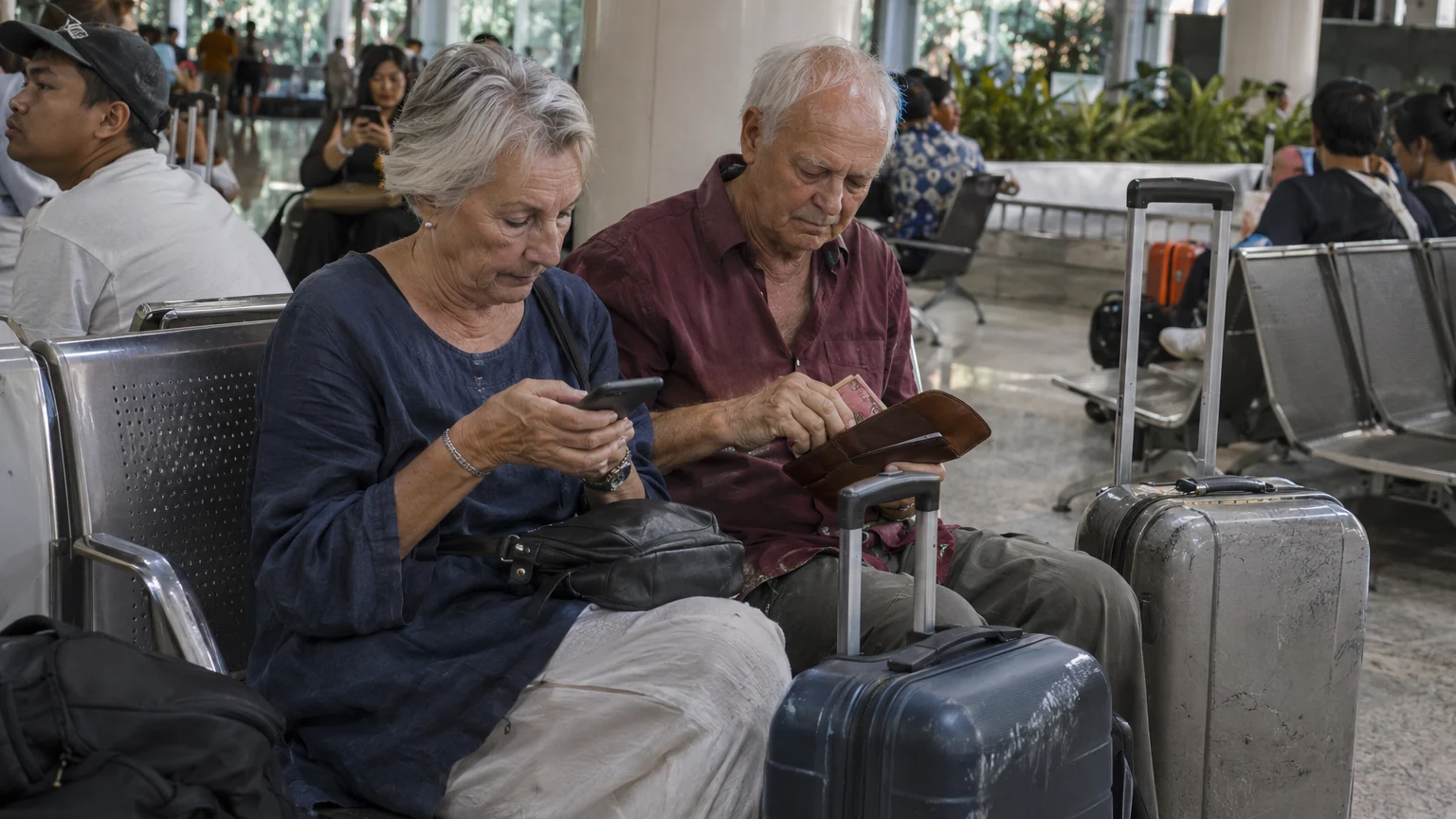
Payment methods and costs depend on your route, bank, and the terms at each location.
| Situation and expenses | What to check in advance | Backup option |
|---|---|---|
| After arrival: transfer, food, transport to your accommodation | What is already paid for and how to get rupiah before your first payment | Rupiah bought in advance or a confirmed exchange option on arrival |
| Everyday purchases and travel | Which payment methods are accepted along your route and where to get cash | Enough rupiah to last until the next available exchange |
| A reserve for the rest of your trip | Whether you can use it without your main card | Foreign cash stored separately, with a confirmed place to exchange it |
At a market, small cafe, or shop, check the payment method and whether change is available for a large banknote. At a shopping mall, check whether your card is accepted; at a hotel, also check the billing currency and deposit terms. Have small rupiah banknotes ready for your upcoming purchases.
For both Russian and foreign cards, you need to check the specific card product. The issuing bank's country and the payment network are different characteristics. Ask your bank separately about paying in Indonesia and withdrawing cash, then confirm the fees and the currency in which your account will be charged.
An ATM may offer dynamic currency conversion: you receive rupiah, but the amount is converted into your card's currency in advance. Visa recommends choosing the local currency to avoid the markup on this conversion. ATM fees and your bank's charges may still apply.
If you plan to visit several islands in Indonesia, check access to cash along your entire route. A seller displaying a QR code does not by itself confirm that you can pay using your app.
What should you check before exchanging dollars or euros for rupiah?
Before exchanging money, confirm the provider's authorization, the acceptance terms for your banknotes, and the final amount of rupiah. For a non-bank exchange office, check its legal name and status against the list of operators on Bank Indonesia's website. The Authorized Money Changer sign and license details help you identify the provider, but you need to verify the specific name.
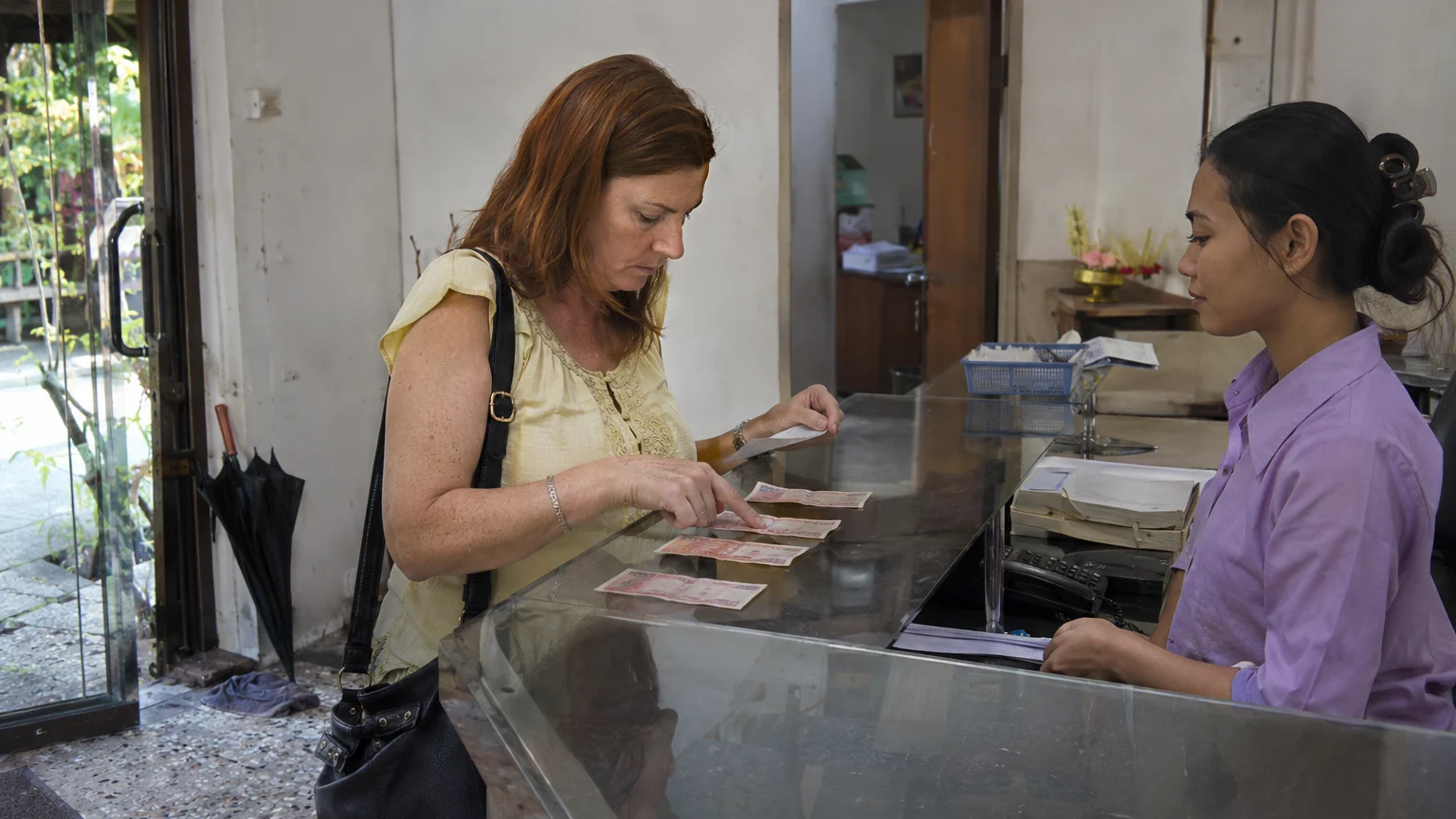
Being in a tourist area does not by itself confirm that an exchange office is authorized. Before handing over money, clarify which direction the rate applies to: how many rupiah the provider will give you for your dollar or euro. Ask whether the offer differs depending on your banknotes' denominations, condition, and year of issue.
Before exchanging, confirm the amount you will receive for your specific banknotes and ask whether all fees are included.
Count the rupiah you receive at the counter, checking the denominations and total against the agreed calculation. Check the transaction receipt and keep it. If the amount differs, clarify the reason before completing the exchange.
Have rupiah ready for everyday payments. Bank Indonesia sets a general requirement to use the local currency for domestic transactions; specific exceptions provided for in the rules do not make dollars and euros a universal substitute for rupiah on a tourist trip.
What should you check before departure to make sure your chosen money will work for the trip?
Before departure, check the currency of your cash, your access to rupiah after arrival, and your backup payment method.
Your cash is ready
You have chosen a currency and confirmed that your banknotes will be accepted.
Your calculation is complete
You have accounted for all exchanges, fees, rounding, and any remaining balance.
Your initial expenses are covered
You know how to pay for transport and purchases before your main currency exchange.
Your card has been checked
Your bank has confirmed the payment and cash withdrawal terms for your card product.
Your backup is accessible
You can get rupiah if your main method does not work.
If you have not yet chosen how to receive money in Indonesia, you can ask ATM24 about an available option. Before the transaction, confirm the available way to receive rupiah, the exchange rate, and the final amount with a manager.
Questions and answers
Do Bali and the other Indonesian islands use the same currency?
Yes, they share one currency: the Indonesian rupiah. IDR and Rp refer to the same money, so you do not need to buy a separate currency when traveling from Bali to another island.
Do you need to buy dollars if you already have euros?
Ask for two calculations using the same starting amount: exchanging euros directly into rupiah and exchanging via dollars. Buying dollars makes sense if you will have more rupiah after the additional transaction and all fees.
Should you buy rupiah before departure?
This can be convenient for expenses before your first local exchange. First, check availability and the total purchase cost; you do not have to exchange your entire trip budget in advance.
Can you count on exchanging rubles after arrival?
Only if a specific provider has confirmed that it accepts rubles and has provided terms for your amount. Without that confirmation, prepare another currency or a verified way to get rupiah.
Which dollar or euro banknotes should you prepare?
Tell your chosen exchange office the denominations, year of issue, and condition of your banknotes. Ask it to confirm acceptance and the amount you will receive: one provider's requirements should not be assumed to apply to all exchange offices.
Which currency should you choose if an ATM offers conversion?
Choosing IDR lets you decline the ATM's conversion offer and leave the conversion to your bank or payment network under your card's terms. Before confirming, check for a separate withdrawal fee: declining conversion does not remove it.
Leave a transfer request
We agree the payout method, the rate and the route before payment and reply within 5 minutes in the channel you prefer.